Archive for November, 2009

Nov 24 2009

Profile Image of Avi Gordon
Avi Gordon

Warren Buffett undervalues you at $1million after your MBA

Last week Warren Buffett told 700 Columbia Business School students: “Right now, I would pay $100,000 for 10 percent of the future earnings of any of you.”

Seven hundred Columbia GSB students had crammed into the Roone Arledge Auditorium to hear the Sage of Omaha, accompanied by Bill Gates. Buffett (Columbia class of ’51) helped, if you couldn’t do the math: “Many of you are a million-dollar asset right now.”

There’s nothing unique about Columbia in top-tier MBA company. Buffett would make the equivalent offer to graduates of other top-tier MBA programs.

And I’m sure Buffett’s offer is dead serious — if any top-tier MBA graduate were fool enough to sell at that price! Warren didn’t become the world’s greatest investor by overpaying for his stock, therefore of course he assesses the average future value of Columbia business students at far greater than $1m. (He champions “value investing” — analyzing a company’s real long-term value and buying securities priced well below that.)

Effectively the careful, savvy Buffett is saying he commercially “values” anyone picked by Columbia (or equivalent) Adcom as, at minimum, a million-dollar asset even though he has never met him or her. He trusts Adcoms to have picked the right people, top faculty to have adequately prepared them, and the careers office to be able to place them into high-return jobs, so that his investment would soon show returns.

What this tells you is that the brand value of a top-tier MBA holds up exceedingly well in the eyes of the smartest people, despite the recession, despite alleged MBA complicity in the Credit Crunch, and so on.

There was another lesson for those who would like to be one of the 700 (or equivalent) next year. As reported in Columbia University’s The Record, David Lin, 26, a second-year MBA student from Los Angeles said Buffett’s success “proves you don’t have to be a jerk or have a huge ego to get ahead in this world. He’s a role model for everyone, not just investors.”

As a normal ego, non-jerk, Buffett is an important role model for MBA applicants too.
No responses yet

Nov 17 2009

Profile Image of Avi Gordon
Avi Gordon

Using ‘Maslow’s hierarchy of needs’ to develop the why-an-MBA / goals essay

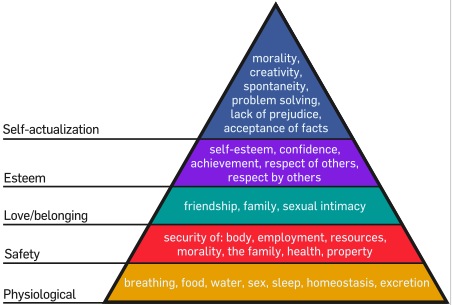
Psychologist Abraham Maslow created a 5-level theory of human motivation (Psychology Review, 1943) in which he proposed that peoples’ needs and satisfaction move ‘upwards’ through a common structure which he called a ‘hierarchy of needs.’ Once lower needs of sustenance and safety are met, we aspire to fulfill social, self-esteem, and self-actualization needs. The summary chart looks like this:

Mazlows Hierarchy MBA Using Maslows hierarchy of needs to develop the why an MBA / goals essay

credit: Wikipedia

(The model made Maslow world famous. The structure of the pyramid itself has been tinkered with over time, for example by Manfred Max-Neef, who sees levels of: subsistence, protection, affection, understanding, participation, leisure, creation, identity, freedom.) But the core insight remains: once more basic levels of fulfillment are achieved, and as long as they remain achieved, humans moves up the hierarchy in search of fulfillment.

What does this have to do with MBA admissions essays, and how does this help those struggling with the ‘why an MBA?’ question in particular?

It helps because it provides a quick, reliable guide to the necessary reach of the essay. Too often applicants dwell in and around levels 2 and 3, talking of security and quality of employment, taking care of their family (including elderly or immigrant parents) and developing friendship and contact networks (incl. alumni networks), career progress, and so on.

This is all important. But there is more to say, and Maslow shows the way to developing it. Where is the rest of your motivation going to come from in your life: how will you achieve further self esteem, self-respect, and the respect of others? What will you create? What will put you, personally, to higher plain of self-actualization?

As I tell my clients: A good career and family security are great things to want. But what else is there? What comes after that? You don’t need to aspire to be Nelson Mandela or Mother Theresa, but you do need to reach into yourself and ask: ‘My levels 4 and 5 - what are they, for me? What would actualizing myself at these levels look like? And how will an MBA be part of what takes me there?’

2 responses so far

Nov 09 2009

Profile Image of Avi Gordon
Avi Gordon

Making messages stick: an MBA Studio ‘bible’ gets some airtime

As a follower of many blogs in the MBA admissions ‘space’ I know, as you probably know, that they are of mixed quality. But the musings of AIGAC-accredited MBA admissions consultants is generally good, and I find we are of one mind on most important matters. So no surprise that today’s post is a hearty agreement with Linda who recently recommended the book Made to Stick (Random House, New York, 2007) by Chip and Dan Heath, on her Accepted blog.

made to stick Making messages stick: an MBA Studio bible gets some airtimeI read the Made to Stick hot-off-the-press two years ago, and have integrated every aspect of it into MBA Studio’s client offerings ever since. It’s not the only resource I use of course (and my own MBA Admissions Strategy, which predates it, has many of the same principles.) But Made to Stick is unsurpassed in focusing on one single thing: getting a message across. Formulating it so that the reader reads it, understands it, remembers it.

So, as I have said consistently to MBA Studio clients and whomever else would listen: this is the single best “non-MBA” guidebook for MBA applicants. Be aware that it won’t help with the key aspects of determining who you are and what your key value points and application platform are — what you want to communicate in the first place (as revealed and coached through MBA Studio’s signature “Profiling” process.) Nor will it help with the specifics of how to manage and beat business-school-specific expectations in essays and interviews and reco’s. But as a book about how to communicate a message, it can’t be beaten, and is justifiably a worldwide bestseller.

The Heath brothers have distilled what makes a message “stick” into six principles, which they communicate in a (sticky) acronym, SUCCESs (sic). That is Simple, Unexpected, Concrete, Credible, Emotional, Stories. Chapter by chapter they show how to simplify a message to its essence; grab attention via its unexpected elements, use concrete rather than abstract intelligence; enhance credibility via various proof channels; and achieve emotional connections with the reader. Telling stories that matter, and telling them well, is the key to much of this.

Made to Stick has a blog by the way. Unfortunately two years and counting after the book was published, it’s only occasionally active.

One response so far

Nov 02 2009

Profile Image of Avi Gordon
Avi Gordon

Attention to detail, cont. Answering the MBA essay question exactly as posed

Further to my post last week on ‘the business school and the avocado’ — the importance of attention to detail and showing the effort you have put in to achieve it — I can add a coda directly from an MBA Director of Admissions:

Says Rose Martinelli, Assistant Dean of Student Admissions at Chicago Booth on her blog this week, “I thought I’d take a break from reading to share a few pointers about what I’ve learned about this year’s application. After you’ve completed your self-assessment and researched which schools fit your needs, then it is absolutely important that you READ and ANSWER the questions each school is asking. I say this largely because many schools have quite similar essays this year. For example our Essay 2 asks you to answer one of these two choices (500-750 words):

A. Describe a time when you wish you could have retracted something you said or did. When did you realize your mistake and how did you handle the situation? or
B. Describe a time when you were surprised by feedback that you received. What was the feedback and why were you surprised?
HBS asks: What have you learned from a mistake? (400 word limit); and
Wharton asks: Describe a failure that you have experienced. What role did you play, and what did you learn about yourself? (500 word limit)

While we recognize that you are likely to apply to multiple schools, it’s important that you make sure you answer each schools’ questions carefully. Your attention-to-detail, effort, thoughtfulness, judgment in choosing which essays to answer, etc., help us to learn more about you and your candidacy for Booth. It’s not just the words you use…”

There you have it as clear as you could like it. First, attention to detail and effort does not go unnoticed or unrewarded, and in fact answering the Booth question in such a way as it could equally be an answer to the similar Harvard or Wharton questions will be poorly received. Second, tailoring your answers carefully to each precise question forms part of Adcom’s assessment of your detail-effort contribution.

None of this suggests you should not reuse material across multiple MBA applications; just that it has to be done with great care not to compromise the exactness of your answer to the specific question each time. If not, you’re coasting, and you can’t expect Adcom to reward you for it. There are ways of judging which parts of your essay ‘port’ to the new, similar question, and we’re happy to help you with this.

No responses yet

SEO Powered by Platinum SEO from Techblissonline

Switch to our mobile site