Book
MBA Studio’s book, MBA Admissions Strategy: From Profile Building to Essay Writing, by Avi Gordon (McGraw Hill Professional / Open University Press, 2005) has been widely acclaimed by independent media and critics, and amazingly well-received by MBA admissions applicants. See reviews and comments on Amazon.com, Amazon.co.uk, Business Week, About.com, MidWest Book Review, and GMAT Club.
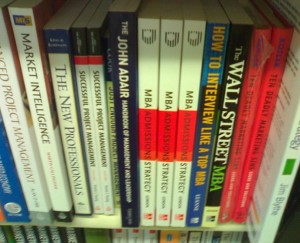
MBA Admissions Strategy, kindly photographed at Magrudy's Bookstore by an MBA Studio client in Dubai.
INSIDE:
Section 1: Competitive Strategy analyses the behind-the-scenes culture and practices of admissions and how to promote yourself in this context. It discusses the attributes schools look for, and how to negotiate the filters Adcom uses in screening applicants.
Section 2: Profile Development outlines a system to identify the competitive value in your background, how to construct your value profile from this, and turn it into a compelling message.
Section 3: Essay Management is about essay questions and how to fit your profile to them: how to know what to write, which essay to write it in, and how to write it well.
Section 4: Writing Technique is about writing better. It provides templates for organizing specific essays, gives solutions for improving expression and avoiding essay pitfalls, and a checklist of do’s and don’ts.
review-mba-admissions-strategy-b y-av-gordon2.aspx [now factset.com]
.
Here’s a review from a current Wharton student: “The nice people at MBA Admissions Strategy sent me a copy of their book a long time ago, but I haven’t had any time to post a review. In my opinion, this book is really great. I wish that I had it when I was applying. It has some really great insight into the strategies that you should use when creating your applications. It goes into everything from identifying your themes to approaching the most common types of essay questions. Other books are great for tactical advice (what to do when, how to go about it, etc), but this book mirrors my own personal philosophy about how you need to think about each step in order to create the best application for yourself. Highly recommended. In fact, I gave this book to a special someone that is applying this year. Check it out (link below to Amazon where you can see the 5 star rating!) Tinydancer’s MBA Blog.
.
CONTENTS
.
SECTION ONE: STRATEGY FOR THE ADMISSIONS PROCESS
1. Marketing to Adcom Getting elected. Seeing the world through Adcom’s eyes. “People people.” The reward system for admission officers. Business schools compete too.
2. What Satisfies the Admissions Committee?
The key attributes. Summary: A CEO in waiting. It’s your future not your past that counts. The four attribute dimensions. A four-part interlocking profile. Class balance. Highlighting diversity contribution. A two-way fit. Understanding the school’s market positioning. Start with your needs.
3. Strategy Fundamentals
Researching and choosing schools. Dig behind the websites and glossy brochures.
Visiting the campus. How many schools? GMAT strategy. Managing references and referees. Priming referees. Referee fatigue. Interview strategy. Understanding behavioral questioning. International applicants. Foreigners for US schools. Americans for foreign programs.
4. What Goes On After You Hand In Your Application
The committee meeting. Application timing issues. A basic timeline. The role of the essays. Fine-tuning selection. Rewarding strengths outside the classroom. Communication skills. Meeting the essay requirements.
.
SECTION TWO: PROFILE-BUILDING TECHNIQUES
5. The Profiling Project
Profiling: Why do it? Creating an alternative basis for essay responses. Preparing for behavioral questioning . Brainstorming methodology. Shadowing the essay process. Finding and developing stories. Subjective realities and formative events.
6. Personal Profile Analysis
Personal features and attributes. Activities. Accomplishments and achievements. Skills and strengths. Difficulties, failures, and weaknesses. Leadership. Major influences: people. Major influences: culture and environment. Life-changing events and experiences. Diversity and contribution. Values and philosophy. Personal goals.
7. Professional Profile Analysis
Characteristics and qualities. Activities. Accomplishments and achievements. Skills and Strengths. Difficulties and failures. Weaknesses and inexperience. Leadership. Influences. Change and growth experiences. Difference and diversity. Values and philosophy. Professional goals.
8. Positioning, Messaging, and Mapping
Reducing complexity. Selecting and grouping. Extracting themes. Which themes to choose? Theme example. The application message. Applying marketing principles. Message techniques. Mapping your message to the essay questions. Towards the question archetypes.
.
SECTION THREE: ESSAY MANAGEMENT
9. The MBA Question Archetypes Message Mapping. “Why an MBA?” Strengths,success, and achievement. Weaknesses and failure. Leadership. Contribution. Ethics and values. Teamwork. Key influences, mentors and role models. Direct personal inquiry. Creativity and innovation. Community service, self review, and the optional essay. Multiple archetypes in one essay.
10. Mapping Approaches
Balancing the essay set as a whole. Category approach. Theme approach. Plugging the holes. Mapping Essay Set One. Archetype analysis and mapping. Assessing gaps and openings. Revised mapping.
.
SECTION FOUR: WRITING TOOLS & METHODS
11. Principles of Better Writing
Relevance and importance. Passing the “so what” test. Perils of “the written word”. Deleting the bits that readers skip. Choosing and managing human-interest stories. Show, don’t tell. Specific, detailed and concrete prose. The 13 essay pitfalls to avoid.
12. Idea Discipline: Outline and Structure
Persuasive writing. Classic structures. Outlining. Signposting. Thesis statement.
13. Writing the First Draft
The introduction, body & conclusion. Summary: the “take-home” message
The first draft and essay revisions. Where do I start? The cooling period
Further drafts: revising and re-rewriting. Reusing material for other applications.
14: Improving expression: Word and Sentence Strategies
Techniques of writing clarity and simplicity. Brevity. Everyday language. The active voice. Using more and better verbs. Handling conjunctions and pronouns.
Conclusion
Appendix: Essay Revision Checklist
.

Responses