Archive for July, 2010

Jul 30 2010

Profile Image of Avi Gordon
Avi Gordon

How Mr Swatch can take you past management consulting as an MBA admissions platform

The Economist recently ran an obituary of Swatch magnate Nicolas Hayek, and this offers me a concrete example to explain why management consulting is a weak long-term goal for MBA admissions.

(Yes, I’m always pushing clients to give clear examples or anecdotes to back up their MBA admissions claims. So this is me “practicing what I preach.”)

In 1982 Hayek was brought in as a management consultant by a group of banks to advise them on the sale of Switzerland’s last big watchmaking conglomerate which they had bailed out a few years earlier. But, rather than merely consult on sale-exit strategies, Hayek created and led a group of industrialists who bought the conglomerate from the bankers, and built it into the world’s largest watch company, with almost a quarter of the global market, with Swatch as the lead brand.

As the Economist says: “Mr Hayek’s strategy of making cheap watches more cheaply and expensive watches more desirable helped lift the rest of the Swiss watch industry, which is once again leading the world. Last year Swiss firms exported nearly 23m timepieces worth more than $12 billion, a figure that would undoubtedly have been far, far smaller had Mr Hayek stayed in management consulting.”

The point is: Hayek had two careers ahead of him in 1982. He could have stayed a management consultant, advising on deals, for a fairly prestigious, reasonably well-paid life. Or he could do what he did: turn the ailing consortium around through industry-innovative operations, cost restructuring, and marketing management, to totally renew the Swiss watch industry. He was a leader, innovator, decision-maker, and business-builder at the ultimate level.

If Hayek was to have presented his career options to Harvard or INSEAD or LBS, etc., which of the two routes do you think the b-school Adoms would have favored more?

Don’t get me wrong. It’s fine to say you want to spend some time in MC in the short term, taking advantage of the rapid exposure to different industries and skills. But at the end of the day, management consultants are advisors, not doers. They are always the bridesmaid, never the bride. If Hayes had stayed a management consultant his value to everyone (including his MBA alma mater) would have been a fraction of what it became, and his obituary would never have been splashed across the world’s financial media.

When the admissions committee of a top MBA program is looking at you, they want to think that you may possibly one day be somebody like Hayes (in your own industry and in your own way.) If your career goal is consulting itself, you are telling them there is no chance of that.

One response so far

Jul 23 2010

Profile Image of Avi Gordon
Avi Gordon

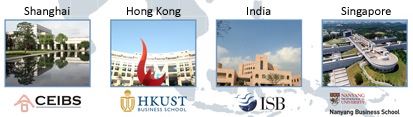
‘Ivy League East’ MBAs unite to brand themselves as ‘Top 4 Asia B-schools’

Many industries have seen a shift from the US / Europe to Asia, yet, somehow, education has been one of the slowest sectors to make this transition. Certainly at the elite level there has always been, and remains, a significant migration westward to attend brand-name universities. Institutions such as Harvard and Oxford have unbelievable prestige across the Orient and this is not going away any time soon.

But there are straws in the wind, and the wind is blowing the other way.

As an admissions advisor I’ve started to hear Americans and Germans and Canadians and Italian nationals saying this kind of thing: “My target schools are Harvard, MIT, LBS, and HKUST, and Nanyank.”
.

top 4 asia mba Ivy League East MBAs unite to brand themselves as Top 4 Asia B schools

.
Now four Asian schools have gotten themselves together under the banner “Top 4 Asia B-Schools” to solicit applicants from North America and Europe. The Top 4 are the Indian School of Business (ISB), Hong Kong University of Science & Technology (HKUST), China Europe International Business School (CEIBS), and Nanyang Technological University (NTU, Singapore). The programs are all well-ranked, all accredited by AACSB (US) or EQUIS (Europe) or both, and feature prominent Western faculty.

The admissions implications: First, none of these schools are easy to get into. Part of their growing exclusiveness, part of reaching the top-tier and staying there, is having admissions policies that turn away similar percentages as those dinged by top US / EU schools (about 85% on average.) So there won’t be any “gimmee’s”. But, having said that, the Asian programs are very keen to balance their intake between East and West, so for now a foreigner stands a much greater chance of admissions than a local, all other things being equal.

Second, these four (and other) Asian schools are going to grow further in prestige. This is similar to what I said about the new Johns Hopkins Carey School MBA here. Look ahead and realize that while CEIBS et al does not sound as good as UCLA now, during the span of your career it no doubt will, and the MBA branding, alumni network etc., will be just a strong.

Footnote: According to the CEIBS site, teams from the Top 4 Asia B-schools will attend QS MBA fairs this fall as a group. The dates are:

North America
• Los Angeles: September 11th, Wilshire Grand Los Angeles
• San Francisco: September 12th, The Fairmont San Francisco
• Toronto: September 19th, Metro Toronto Convention Centre
• New York: September 25th, Hilton New York

Europe
• Paris: October 9th, Palais des Congres
• London: October 23rd, QEII Conference Centre
• Madrid: October 26th, Husa Princesa

No responses yet

Jul 12 2010

Profile Image of Avi Gordon
Avi Gordon

What Chicago-Booth expects in its 2011 application essays, in their own words

MBA Studio’s mantra is, “when Adcom talks, listen.” Don’t just hear. Really, really listen because these are the people who are choosing the few and dinging the many. The Chicago-Booth 2011 MBA application essay questions were posted on July 7, along with a post from Rose Martinelli, Chicago-Booth’s Associate Dean for Student Recruitment and Admissions, explaining the thinking behind each, including the new “blank pages” essay:

“Our essays continue to be a wonderful way for us to learn about what makes our applicants unique and determine if they are the right fit for Chicago Booth. Here is some insight as to what we’re looking for in each essay.”

1. The Admissions Committee is interested in learning more about you on both a personal and professional level. Please answer the following (maximum of 300 words for each section):
a. Why are you pursuing a full-time MBA at this point in your life?

b. Define your short and long term career goals post MBA.
c. What is it about Chicago Booth that is going to help you reach your goals?
d. REAPPLICANTS ONLY: Upon reflection, how has your thinking regarding your future, Chicago Booth, and/or getting an MBA changed since the time of your last application?

“These short essays will require you to know yourself. You will need to understand where you have been and where you are going. Before you begin drafting the responses to these essays, take some time for self-reflection. Why do you want to return to school? Why is the MBA the right degree for you?

“We know that many of you will use your MBA experience to help you figure out what kind of job to pursue next. Even though your future career plans may not be clear at this time, you should still be able to discuss your goals and how they relate to obtaining an MBA.

“For our reapplicants, question 1d is where you can tell us what, if anything, has changed since the time of your last application. What has occurred in your life or career that has either reinforced or changed your goals? What lessons have you learned or how have you grown since you last applied to Chicago Booth?”

2. Chicago Booth is a place that challenges its students to stretch and take risks that they might not take elsewhere. Tell us about a time when you took a risk and what you learned from that experience (maximum of 750 words).

“You’re probably wondering, “What kind of risk do you want me to discuss?” To be honest, we’re not looking for one kind of risk in particular. It can be a risk related to your professional, academic or personal life. It can be a risk that resulted in either a positive or negative outcome. We want to hear about a time when you challenged yourself and what you learned from that experience. How has that experience influenced your future actions?”

3. At Chicago Booth, we teach you HOW to think rather than what to think. With this in mind, we have provided you with “blank pages” in our application. Knowing that there is not a right or even a preferred answer allows you to demonstrate to the committee your ability to navigate ambiguity and provide information that you believe will support your candidacy for Chicago Booth.

“Earlier this year, there was some discussion as to whether we would continue using the presentation as part of our evaluation process. With the presentation proving to be such an important tool in helping us determine who is a good fit for Chicago Booth, we decided it was necessary to include in our 2011 application. However, this year, we are giving applicants even greater freedom to decide what information they want to convey in the presentation.

“Since we’re providing you with “blank pages,” what you decide to address in your presentation is up to you. Look at the other aspects of your application. Are there messages or activities that you have not yet been able to communicate to the committee? If so, then the presentation will be an opportunity for you to provide us with this type of information. After reviewing your presentation, we want to have a better understanding of who you are and how you think.

“Also, please remember that it is the content – not the design – that should be the focus of the presentation. We understand that not everyone is a design guru. So, whether it’s through photos, images, graphs, or just words, the goal is to communicate your messages as effectively as possible.”

So what is Rose saying? The essays tell her and her committee who among the applicants is unique, and why so, and (conversely) whether they will fit in. They demand you know yourself well, that is provide evidence of genuine self-reflection. They value risk-taking and the self-insight it brings. Like many other programs these days, Chicago-Booth doesn’t expect you to have a career blueprint, but does expect you to have thought carefully about your goals, and therefore why you need an MBA now.

When it comes to the blank pages essay, Martinelli hasn’t said much, at least not yet. The core of it is clearly contained in the term “navigate ambiguity.” My take is Chicago-Booth wants to see what the applicant can produce in unguided, unstructured situations. Are you just good at following instructions (such as essay prompts); or are you even more capable? That is, can you determine and select compelling material to share with Adcom without any specific guidance. Can you set the agenda rather than merely follow it?

No responses yet

SEO Powered by Platinum SEO from Techblissonline

Switch to our mobile site