Tag Archive 'MBA Adcom'

Dec 17 2010

Profile Image of Avi Gordon
Avi Gordon

Do you know where the ‘empty calories’ are in your MBA admissions essay?

Let me quote wikipedia: “Empty calories are a measurement of the energy present in high-energy foods with poor nutritional profiles, typically from processed carbohydrates or fats. An empty calorie has the same energy content of any other calorie but lacks accompanying nutrients such as vitamins, dietary minerals, antioxidants, amino acids, or in the case of refined grains, fiber.”

Empty calories define most fast food, sugary drinks, and popular cereals — so much so that regulators have reigned in advertising low-food-value items to children. (Food conglomerates have responded by adding back vitamins, minerals, etc. to cereals and other prepared foods.)

Why do I raise this? Because an MBA admissions essay — like any other piece of writing — is a meal for the reader. The reader’s hope and quiet prayer is that the text will deliver the informational nutrients they are looking for, with little fat or waste.

Consider something like this: “My journey to this point has been challenging, but the lessons I learned have been most meaningful — I truly have seen that a new beginning is an opportunity to start again, that life’s challenges are the best way to show one’s capability and forge memorable experiences, and that through passion and perseverance one can make a difference in the world.”

Or this: “I believe the best leaders are those who do things for the right reasons, grounded in a thorough understanding of economics, business, strategy, and innovation. I want to be a leader who is open-minded, can manage complex situations, and empowers people.”

Forget the turgid writing and cliche’s-running-amok for a moment. That can be fixed. The point is, even if fixed, there is still nothing there. From the Adcom readers’ point of view there is no nutrition in the text, nothing that tells them anything interesting or specific or memorable about these applicants and why they should be admitted to b-school. There is no data, there is no record of action, no unique insights. Just words taking up space. That is, just empty calories.

The task of MBA essays is to explain your admissions value to Adcom, and you can’t achieve this via empty text. You must present nutrition-laden text, or expect to be dinged.

This means excoriating anything and everything that tends towards vacant, weary generalizations. Cut that to create space for reader nourishment — discussion of specific well-chosen experiences that show you in action, developing unique skills and fresh non-obvious insights about yourself, about your future aspirations, and about management and leadership.
.

No responses yet

Dec 03 2010

Profile Image of Avi Gordon
Avi Gordon

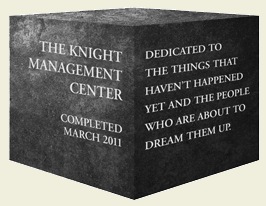
‘Dedicated to the things that haven’t happened yet and the people who are about to dream them up’

I spent a few minutes today catching up with the Stanford GSB Dean’s “State of the School, Fall 2010″ message, which anticipates the GSB’s move into the new Knight Management Center in Spring 2011.

Stanford Knight Center Dedicated to the things that havent happened yet and the people who are about to dream them up

What caught my attention, from an MBA admissions perspective, is the inscription on the new cornerstone of the new center. How is that for clarity in what Stanford GSB is looking for? Dreaming up — and presumably then building — new things is, literally, the cornerstone of the institution.

So if you are applying to Stanford GSB, you need to have some idea of what (ambitious) business or organization or innovation you may dream up, why it’s important to the world, why you are the person to do it, why SGSB can expect you to succeed, and a sense of how they can help you.

Is this saying, “think small?” Is this saying, “comfortable career track?” “Sure, we want to educate you so you can be a trader in an I-bank, or telecoms strategy consultant…?” I think not. They are not demanding mainline entrepreneurship exactly, but they are demanding those ready, willing, and able to build big new things in the world.

It’s also worth spending the 4 minutes it takes to watch Dean Saloner’s presentation, below, because he integrates key elements in the business school education framework, from perspective to foundations to critical-analytical thinking to innovation to personal leadership in a very joined-up way. As an applicant, it’s worth pausing to think how this simple pattern can be used to structure stories and events in your own life that you are trying to tell Adcom about.

.

No responses yet

Nov 24 2010

Profile Image of Avi Gordon
Avi Gordon

‘I’ve traveled the world, this is good for MBA admissions, right?’

I’d estimate that 3 out of 5 MBA applicants to top-tier schools have traveled widely, for work or for fun. It follows that in their MBA applications they cite travel as an activity they value and put it among the important experiences they have had. They think that journeying across the world speaks for itself as proof of “diversity.” Travel “broadens the mind” and all that.

This is true. But there is a lot of value to be had in travel that MBA applicants often don’t get to. Here I tip my metaphorical hat to the mother of an MBA Studio client who gave her son the following feedback — before he came to me — which absolutely dovetails with how I exhort clients to squeeze admissions value from their travel (and other) experiences. I quote:

“I don’t think you have written something meaningful enough about your travels. You have traveled widely but it looks like it doesn’t seem to have influenced you, affected your outlook about people, society.

“Perhaps write something meaningful about poverty, and yet the ingenuity of people who have very little but are innovative, creative, hard working.

“Can you think of reasons why you chose to travel to these places, culture, philosophy, history, etc.?

“Some insight into the way you and your friend chose to travel, no fuss, not staying fancy places.

“This travel was a test also in being independent, showing initiative, taking calculated risks in foreign places. (You don’t give yourself sufficient credit for these things.)”

If all mothers had this depth of insight, I’d be out of a job. But, seriously, the task here, and everywhere in MBA admissions, is to extract the full admissions value from any activity you have done, experiences you’ve had, or choices you’ve made.

Look at your experiences, look at the skill sets and character traits of middle-to-senior managers, and make the link.

In this case an applicant following this advice would be showing Adcom not just “travel,” but a nuanced outlook on foreign cultures; an appreciation of genuinely alternative value systems and social cohesion including alternative forms of innovation; a non-materialist sensibility; an ability to ride out adversity; practice at calculated risk-management, and so on. Now this is a platform a good b-school can build on, to create a senior manager for significant 21st Century organizations.

.

No responses yet

Nov 16 2010

Profile Image of Avi Gordon
Avi Gordon

Managing the MBA admissions interview as a fake fireside chat

As promised, more on MBA admissions interviewing. The difficulty with interviewing (of all types) is that it is a test of “total communication.” That is, it is not just what you say, but how you say it. And this how includes judgment of your expression, tone, confidence, body language, and so on.

The further difficulty is that interviewers “read” these communication signals differently in different contexts and cultures. Now, this is not an anthropology dissertation, and I have no expertise in interview styles across the world, so for clarity let me just stick to US cultural expectations and norms, which are often confusing for foreigners (and Americans too!)

MBA applicants interviewing for a US business school face a contradictory injunction. They are expected to be very formal in dress and politesse before and around the interview, but at the same time (read the guidance on the b-school sites if you don’t believe me) the interview is positioned in *very* familiar terms, as a get-to-know-you event, a conversation, a friendly chat, etc.

This is a “mixed message” if ever there was one. Do they want formal or informal? Both, in different ways. You need to be able to play the formal game, but also be “American” in your ability to be casual and egalitarian across age and authority lines. So while you are dressed like a stuffed chicken, you can still, with permission, call your interviewer “Bob” and so on.

This is, all-in-all, a hard thing to get right for 30 min. One of the images I like to use in interview rehearsal is to get applicants to visualize themselves in a “fireside chat.” That is, to strive for a balanced friendly conversation that bubbles along merrily as if one was having a totally relaxed 1-to-1 in intimate surroundings. This is fake of course, because underneath you have your agenda (transmitting admissions value) and they have theirs (judging you.)

The way get the conversation to bubble along is to make sure there is never a one-way question-vs.-answer dynamic. Bear in mind you can’t ask questions of the interviewer until the very end, when he or she will (formally) signal that this is now appropriate.

So how do you do that achieve a more balanced conversation? One way is not to stop dead when you’re done answering one question, but rather look for a natural segue between topics, ending your answer to one question by saying “which leads me to tell you about…” and then marching off onto new terrain you want to cover. For example, you can end your answer to a “why-an-MBA” question by saying “Which leads me to: why MIT-Sloan? …” Or you can finish a question about managing a tricky report by moving on to how this experience will benefit your team-building skills on campus, and so on.

It’s a technique that has to be used subtly, scanning for visual confirmation that you have permission and are on-topic in broad terms. But if used well, the interview will have a better “formal-casual balance,” and that’s to your great advantage.

No responses yet

Oct 15 2010

Profile Image of Avi Gordon
Avi Gordon

Answering the QS World MBA Tour’s admissions questions in 100 words or less

Topmba.com recently asked for my brief and succinct summary input for an upcoming story on MBA application essays and letters of recommendation. If nothing else it was a challenge in writing tightly. And as it turned out, it provides a summary of some key deliverables and concerns, so I thought I’d share the experience here:

What should/shouldn’t MBA applicants include in their admissions essays?
Applicants should include points that carry admissions value. What is value? Any attributes or experiences that are relevant to peer education and not common in the applicant pool; anything that will get you noticed or make you stand out as a worthwhile addition to the classroom, on campus, and one day in the alumni network. What not to include? Don’t praise the school (they know they’re good); don’t repeat items on your resume; don’t denigrate anyone or any organization; don’t whine about life’s obstacles or blame others. Finally, don’t state the obvious — if you are talking about water you needn’t add that it is also wet.

Who should/shouldn’t they ask for letters of recommendation?
Reco’s are Adcoms only reliable way of finding out what you are like in a professional environment. Therefore, do not ask one of an old professor, your yoga instructor, your priest and so on. You need a reco from your current work supervisor (if not, explain why not) and other reco’s should come from other current or past professional supervisors who know you well. Don’t go for someone with a great title, who hardly knows you. Whoever you get — make him or her give examples and specific instances to back up their claims about you. Brief them on your application content so their communication is consonant with your own. Ask them to to address and reassure Adcom on any weaknesses apparent in your resume, if applicable.

What are the biggest mistakes that many applicants make in their essays?
One common mistake is to try be like a “business school applicant.” There is no one such thing; you will just sound generic and boring. Be yourself, and you will sound genuine and alive and interesting-to-meet. Don’t forget to give specific examples which create interest for the reader. Further, it’s pointless to claim an experience or attribute without giving some proof (a specific example or event or data or awards that demonstrates the attribute is real.) Also, don’t imagine that your reader is a financial or technical person. Adcoms members have a real mix of backgrounds, but at heart they are human resources professionals, and MBA admissions is an HR function.

What are optional essays? Should applicants bother writing them, as they are optional?
Optional essays are used to mitigate a weakness or explain something that may be confusing about your background or career path. They are not a way to get more text in. It is a statement of strength as an applicant not to have to use the optional essay. Only use it if you have something specific to address, and when you’ve addressed it, stop writing — there is no requirement to go to full essay length.

.

No responses yet

Jun 14 2010

Profile Image of Avi Gordon
Avi Gordon

Wharton’s MBA admissions essays for 2010-2011: a challenging set of questions

Wharton’s MBA essays for 2010-11 are great; and very significantly reformulated from previous years, demanding new comment and analysis here.

The required question:

What are your professional objectives? (300 words)

This is in some senses the classic Why-an-MBA? question. What’s new is that it is really short, particularly when compared with the longer questions that follow. The implication is that Wharton, following HBS and others, are putting less and less emphasis on what applicants claim they will do on graduation. They expect to heavily influence that. It is important that you have direction and motivation, but they reckon, and they’re right, that 300 words is more than enough to get that across. Notice that there’s very little space for Why (an MBA) Now? or Why Wharton? If there’s something important to say to that, you’ll have to be really succinct, or work it into one of the other essays.

The optional questions — respond to three of the following four:

  1. Student and alumni engagement has at times led to the creation of innovative classes. For example, through extraordinary efforts, a small group of current students partnered with faculty to create a timely course entitled, “Disaster Response: Haiti and Beyond,” empowering students to leverage the talented Wharton community to improve the lives of the Haiti earthquake victims. Similarly, Wharton students and alumni helped to create the “Innovation and the Indian Healthcare Industry” which took students to India where they studied the full range of healthcare issues in India. If you were able to create a Wharton course on any topic, what would it be? (700 words)
  2. Reflect on a time when you turned down an opportunity. What was the thought process behind your decision? Would you make the same decision today? (600 words)
  3. Describe a failure that you have experienced. What role did you play, and what did you learn about yourself? How did this experience help to create your definition of failure? (600 words)
  4. Discuss a time when you navigated a challenging experience in either a personal or professional relationship. (600 words)

.

Question 1 does a number of things worth noting. First it’s mining for what you, specifically and uniquely, bring to the program. It does not automatically follow that you would create a class around your speciality, but this will be the case for many applicants, and so is a place to show your special attributes, connections, or interests. The question also therefore allows you to show your “fit with Wharton,” not only what you will contribute but what you would like to learn or experience. Further, as the language of the question suggests, it looks toward your innovativeness, which is a core value in MBA admissions. Your choice of class must show innovation with reference to the curriculum as it stands. This of course demands that you demonstrate knowledge of what is already on offer and where the gaps might be. Finally the question tests your realism and knowledge of how b-school electives and/or off-site experiential programs work. You might say “I’ll create a class that goes to visit Nelson Mandela to learn to balance business and policy objectives” but that would show total naivete as to how things really work and what’s really possible, and your application would be in the bin.

Question 2 is a deep, almost wickedly deep, dive into your personal stuff. They are probing the tissue of your motivation, your self-awareness, and self-understanding. The actual opportunity turned down is far less important than why you choose one thing over another, which should takes Adcom right to who you are as a person and what your core values are. Don’t disappoint them in this. Obviously when you turned down an opportunity, it was for a good reason, either a better opportunity or a family obligation or something like that. So what is at stake here too is your judgment and maturity. The question specifically looks to that in asking if you would make the same choice again, in other words, “how have you grown?”

Question 3 is the similar to last year, but the sub-question is new. It is a classic failure question. I’ve written a lot on how to manage failure questions (click on ‘failure essay’ tag,) and in my book. The sub-question that asks about your definition of failure, deepens the motivational, maturity, introspection angles to the standard MBA admissions failure essay. Everyone fails. Not everyone knows why, or demonstrates the self-knowledge or emotional resilience that is core to “bouncing back.”

Question 4 is a fairly typical “challenging situation” question. Of the set it is the one that most clearly asks about your relationship with others — and therefore your role in groups, teams, and so on, although it does focus you on a particular event and a specific 1-to-1 relationship. The ability to manage relationships is key to leadership, and therefore key to business success, and thus key to Wharton Adcom.

All in all, Wharton 2010-11 has put out a really state-of-the-art set of questions. Varied. Behavioral. Hard. But don’t be scared of hard questions. If they were easy you wouldn’t be able to separate yourself adequately from the crowd of pleasantry-and-platitude writers.

No responses yet

Jan 28 2010

Profile Image of Avi Gordon
Avi Gordon

The iPad launch and the evolution of the MBA applicant ‘type’

Last time I spoke about applying for an MBA like Steve Jobs would, by which of course I mean not ‘as if’ you were Jobs, but going about it in the way he would — staying true to yourself and your motivations. Anyway, speak of the devil, the Apple iPad is out and I, like millions around the world, have been drawn into the media extravaganza surrounding its release. So I find myself watching Jobs doing the promotion keynote.

iPad Steve Jobs The iPad launch and the evolution of the MBA applicant type There is Jobs in his blue jeans and sneakers and polo-top, just being completely his geeky self, and it inevitably makes me think about what ‘the image of success’ is these days in the business world, and how it’s changed.

Now, make no mistake, these launches are rehearsed and choreographed and fine tuned for mass marketing appeal - a bit like yesterday’s ‘State of the Union’ address come to think of it. Because projecting an image of success is important. And it is as important in MBA admissions as it ever has been. But Jobs is the poster boy for how that image is has changed. Bankers in dark suits and power ties loosing quantum fortunes and asking for taxpayer handouts somehow ain’t it right at the moment.

I think of the issues I have (and I know other MBA admissions coaches have the same problems) in getting applicants to free up and be themselves, and go beyond being trying to be a ‘square’ or a ‘suit’ in their applications. Why be another young guy in banker dress trying to get himself taken seriously, when the image of business success is currently so … not that.

I know Jobs is in the media-entertainment-electronics industry and a finance guy or even a mainstream consultant couldn’t dress like this - or not yet anyway. And I’m certainly not suggesting that anyone go to an MBA admissions interview in blue jeans. At your MBA interview you do need to show you can play the game.

But there is still plenty of room in what you say, and what you plan to do, and how you present yourself across your MBA application, to show what makes you ‘you’ and therefore unique. It’s definitely what Adcom wants. And chances are it’s what you really want too.

No responses yet

Dec 24 2009

Profile Image of Avi Gordon
Avi Gordon

The pros and cons of social media networking for MBA applicants

Part of the holy grail of a good application to business school is to show why the particular nature of the b-school you are applying to fits with you and what you want out of your MBA. That is, each program has a slightly different ‘signature’ in terms of curriculum, type of students, faculty interest, clubs and extramurals, internship-recruitment opportunities, alumni network and so on, and the task is to show that you understand what that signature is and why it fits with you.

You won’t get a lot of help from looking at the glossy brochure or the school’s glamor Website. That won’t make you enough of an ‘insider.’ The only way to know enough about a program is to get inside it for a while — by interacting with people who are there, or visiting the campus and talking to people who are there.

Social media networking forums have created new options for doing this. You can connect with or ‘follow’ current students or clubs via their blogs or tweets, or their identities Facebook, LinkedIn, etc. If there is a Stanford club entertaining Steve Jobs, it will be on someone’s blog. If Wharton students are on a trek, someone will have uploaded video to YouTube, and so on. Following this assiduously and interacting (politely) where appropriate will give you a window into the nature and culture of the program you are targeting in a way that just was impossible to imagine a few years ago. Beware, quality is mixed to say the least. You will get many perspectives from parties with vested interests that are not aligned with yours. Use them wisely. But overall this is the way to go.

Some admissions officers blog too, and currently Adcoms in general are rapidly revamping their own marketing (seeking to find and attract great applicants) to include social media. More and more authentic and useful insight in each school from the school itself is being offered in this way. See, for example, Chicago Booth Adcom director Rose Martinelli’s very personable blog, The Rose Report. You can follow, interact, and absorb the school’s culture in this way. (Again, be appropriate. Don’t, for example, use a blog comment facility to ask about your own personal application…)

But the downside of social media is this: If you can find and know them in this way, they can find you. Be careful about what you say online and what you have said. I’m not saying that Adcoms “google” an applicant or routinely look them up on identity sites to find out more about them or corroborate what they put down on the forms. They probably don’t. But they very well might.

Expect Adcom to treat you in some ways like a potential employee or client. It’s well known that these days prospective employers or prospective clients, or anyone who wants to look you up on the Web, can and will do so. And when they do they may find that beery and not-altogether-clean bachelor party photo on MySpace. Or they may find a Doostang profile that doesn’t adequately match what you’ve told them. And it’s quite hard, once something is out there on the Web, to take it back.

So be smart about it. Use social networking to get inside a program to research and develop your ‘fit’ argument. Be scrupulous about what is out there under your name, make it consistent with your application platform, and try to take down unprofessional material where you can.

No responses yet

Oct 29 2009

Profile Image of Avi Gordon
Avi Gordon

The little story of the business school and the avocado

In my book ‘MBA Admissions Strategy’ I offer the following advice: ‘Proofread to show your hunger’ (that is, hunger for admission, a real desire to be selected.) Typographic or other careless errors in your text immediately clues Adcom in as to how (un)careful you were with your text, and this tells them not only how organized and detail-oriented you are — whether you are a ‘finisher’ — but also how much you actually really care about your application to their particular school.

In this sense MBA admissions works just like a resume you send out for a job. If there’s one error in it, eyebrows will be raised. Two errors and you may as well not have sent it.

The longstanding ‘pet peeve’ across all schools is that the wrong school name often appears in the text. That is, Stanford GSB Adcom gets essays that say: “I would contribute to my peer learning environment at Wharton by …” Ouch.

Famously, the spellchecker will help you a bit, but is not foolproof. It will happily let you say your first mentor was your high school principle. It will not replace Booth with Tuck. Nor does it know that Haas is a business school, but Hass is an avocado.

The tricky thing is that you, the essay-writing applicant, can’t proofread your own work. Obvious errors will go undetected because you will be focused (rightly) on content and value delivery. The MBA Admissions Studio does not offer this service either, for the same reason. Proofreading should be done by someone who is seeing the essays for the first time, and who is tasked with looking for errors (not reading for content or value assessment.)

No responses yet

Sep 18 2009

Profile Image of Avi Gordon
Avi Gordon

‘I’m unemployed, does this mean my MBA application will be dinged?’

In normal times the answer to this question is ‘yes.’ Unless there is a compelling no-fault reason you are unemployed, or you have just sold a company for a few million bucks, your unemployment will count against you. In a situation where 3 in 20 are admitted, it’s going to be hard to be one of the three.

But these are not normal times. Lots of people have been squeezed out of the job market due to the Credit Crunch and resulting recession. If you’re one of them, Adcom will understand that. The emphasis then shifts to how you have responded: (a) what have you done with your time, and (b) how has the experience changed you? How have you grown? Unemployment often forces on us a period of life-stocktaking, where we have the breathing space to reevaluate our goals or at least ask ‘what do I really want to do next?’ Adcom is interested to see if you can do this ‘personal work,’ and what your answers are.

Keep in mind also that the average senior executive — your role model in your MBA aspiration — will face periods of career upheaval. Showing you can cope with this is a mark in your favor. For a sense of what others are doing and thinking, and particularly how to reflect on this kind of career bump, see the Wall Street Journal blog ‘Laid off and Looking.’

Also see The Rose Report, written by Rose Martinelli, Associate Dean for Student Recruitment and Admissions at Chicago Booth GSB. I’m a big fan of this blog which really walks the walk in making the admissions process transparent. This is what Rose has to say on whether unemployed candidates will get into Booth this year:

“The simple answer is yes! Many people have been displaced over the past year through no fault of their own, and finding a new job in their target industry/function has been equally difficult.

So what can you do? First, take stock of what you have learned about yourself during this time. For many of you, this may have shaken your confidence and impacted what you want to do with your life/career going forward. Help us to understand this in your application. Second, let us know what you have been doing with your newfound freedom and what motivates you. Are you taking classes, volunteering your services, traveling, etc.? There is no right or wrong activity… Again, help us to understand your choices and motivations. As you’ve probably learned by now, we’re so much more interested in how you have coped with these surprises and what you’ve learned about yourself.”

Footnote: back in June I posted an article here about the humanities-based diversity of Adcom’s own career backgrounds, and how this should affect your approach. Martinelli fits this mold too. She received undergraduate and master’s degrees in vocal performance from Northwestern University, and spent 15 years as a professional opera and concert singer before doing an EMBA at Chicago Booth.

No responses yet

Older Posts »

SEO Powered by Platinum SEO from Techblissonline

Switch to our mobile site