Tag Archive 'MBA goals essay'

Nov 08 2011

Profile Image of Avi Gordon
Avi Gordon

Embrace Your Life and Career Inflection Points for MBA Admissions

In differential calculus an inflection (or inflexion) point is the point on a curve where the curvature changes sign and therefore shape.

Lives and careers have inflection points too: those moments where, due to events or new insight, suddenly everything is turned around or looks different.

Inflection points can be “achievements” but they don’t need to be. Often they are mixed, bitter-sweet moments of self-understanding and emotional arrival. Communicating these moments is key to convincing Adcom of your unique, personal, individual motivation for MBA study and beyond.

Sometimes when I talk to clients at the profiling stage of their application — when we sift through their past and present scouring for admissions value — they will blow right past an inflection point such as a change of college major, or death of a parent, or visit to the national gallery in Berlin (or whatever it may be) and I have to slow them down to fully explore and capture the value therein.

Due to confidentiality, I can’t tell their stories, but I did notice an example used recently on the Businessweek MBA Journal site where a now-current INSEAD student shares his “road-to-Damascus” moment:

“A favorable USD/GBP exchange rate and good salaries enabled us to enjoy a hedonistic lifestyle in New York, which included fancy dining, live music and sporting events, and parties on most nights. Yet, during all of this, I witnessed an act of kindness that changed the way I view the world and my aspirations. This moment of humanity would ultimately drive me to pursue an MBA at INSEAD.

“Midway through my training in New York, my friends and I went to see a Yankees baseball game. We caught the subway to return home and sat down next to a homeless man named Sam. Two stops later, another homeless man, J, boarded and sat next to Sam. They proceeded to talk and we overheard parts of the conversation. It became apparent that Sam and J had never met before. Then, Sam asked J if he would like to share some dinner, and J gladly accepted. Sam pulled out a tin of Vienna sausages and some dry crackers, which they shared. We watched all this and lumps gathered in our throats. Sam had no wealth and bleak prospects, yet was willing to share his food with a complete stranger. Would we have shared something worth as much to us with another stranger?

“This act of generosity humbled my friends and me…. I was inspired to seek more in life than those parties and materialistic pursuits. I didn’t want to waste my precious time, and I wanted a challenge. I wanted to make my mark on the world.”

Powerful stuff. Note that you don’t need a bleeding heart story to have an inflection point, or to get into business school. But you do need to be sensitive to the real inflection points in your life, which by definition will be highly individual to you, and how they have shaped your aspirations. This is the key to being real and therefore being believed when you share your goals with the MBA Admissions Committee in your application essays or interview.

 

No responses yet

Oct 26 2010

Profile Image of Avi Gordon
Avi Gordon

MBA Adcom is not a venture capital firm

I’m sometimes asked for the greatest mistakes applicants make in MBA admissions essays, and at some point I’ll pull together my all-time list. But in the meantime, here’s a mistake that I’ve seen a lot of among clients this year so far: muddling up the demands of MBA admissions and a venture capital pitch.

What I mean is, applicants who are on an entrepreneurial track (including social entrepreneurship) and who are therefore talking about a future creating and building a firm, feel they have to make a VC pitch for their proposed venture. They seek to justify themselves in terms of potential market segments, working capital requirements, time to breakeven, and so on.

Now it is always good for MBA admissions to show detailed, careful thinking. And if your “why-an-MBA” is based on a new business, you need to talk about the proposed venture and its industry-market background in a specific and knowledgable way.

But you don’t need to make “the business case.” Adcom is not a VC firm. As long as the idea is not manifestly absurd, they can’t determine if it will actually work, nor are they ever going to try. This is not their skillset, and not their fundamental concern.

Put it this way: A VC firm will “like” a business idea if it thinks it will get out (a investment multiple of) more money than it puts in. If so, the VC will, to quote Dragon’s Den, “make you an offer,” that is, invest cash for a percentage of the business.

MBA Adcoms are not investing cash. They will “like” a business idea enough to make you an offer (an offer of a place in the b-school) if your venture seems broadly plausible, interesting, ambitious, doing something worthwhile in the world, and worthy of an MBA.

So, while you should make a general case for your new product or service, in reality the venture does not have to watertight. You can include the jumps of ambition and enthusiasm that you would have to scrub from a funding pitch.

But there is a wrinkle: Adcom is like a venture capital firm in one way. It is well known that VCs judge two things: the business idea AND the entrepreneur, because they are investing in the person or management team as much as the project. Even a mediocre idea can be a winner, if put in really competent hands. In this sense Adcom mirrors the VC, asking themselves: (whatever the applicant wants to do…) “Can he do it?” Can she pull it off?”

.

No responses yet

Oct 07 2010

Profile Image of Avi Gordon
Avi Gordon

‘If you aren’t an idealist at 25, you’re a rogue; if you’re an idealist at 50 … you’re a fool’

In the headline above I’m paraphrasing Winston Churchill, who is alleged to have said: “If you’re not a communist at 20, you’re a rogue; if you’re a communist at 50 you’re a fool.” In fact the quote in one form or another goes all the way back to Francois Guisot (1787-1874) who said during the French Revolution: “Not to be a republican at 20 is proof of want of heart; to be one at 30 is proof of want of head.” (Republican meant something altogether different from the GOP, of course.)

This quote, in its various iterations is saying: Society expects its young men and women to have ideals and seek to change the world. It expects the fire and passion of youthful optimism and its critique of the status quo, even if it is rash or naive. If the youth do not have that, what do they have? (Whatever they have, it’s worse than naivete.)

When you are in middle-age, then okay, it is expected that you accept certain compromises and adopt a measured cynicism.

Why is the quote important for MBA admissions? Simply, if you are applying for a full-time MBA program you are likely to be somewhere between 23-30; that is still in the age bracket where you should have fire in your belly to change and improve the world. If not, that means you just want to advance yourself and make boatloads of money, and while Adcom likes those driven to succeed, the whiff of narrow self-oriented goals is a golden highway to being dinged.

What does it mean to change and improve the world? See my previous post on this. It does not mean hugging trees in Roanoke or digging wells in Sudan or other “bleeding-heart” welfare-service missions, which, frankly, are a low credibility angle for MBA applicants.

It does mean using your new business and management skills for broader societal benefit, in addition to your own benefit.

Wider benefit that you create can come in developing a new product or service or business model that challenges and improves an industry. To take some famous examples: Herb Kelleher created a no-frills airline (Southwest) that brought air travel to the masses; Ted Turner (CNN) made global news sexy; Mark Zuckerberg (Facebook) developed a platform that brings social communities together in an unprecedented way; Niklas Zennström & Janus Friis (Skype) brought free voip calls to the world — and in the process decimated exploitative national telecoms parastatals.

These were not do-gooders. But they were industry “revolutionaries.” They didn’t look at their sector and say “I just want to be a senior manager and go up the corporate ladder.” Whether as startup entrepreneurs or sitting corporate executives, they were ready to challenge industry status quo’s to build something more ideal. That’s the kind of 20-something idealist you need to be for MBA admissions.
.

No responses yet

Jul 12 2010

Profile Image of Avi Gordon
Avi Gordon

What Chicago-Booth expects in its 2011 application essays, in their own words

MBA Studio’s mantra is, “when Adcom talks, listen.” Don’t just hear. Really, really listen because these are the people who are choosing the few and dinging the many. The Chicago-Booth 2011 MBA application essay questions were posted on July 7, along with a post from Rose Martinelli, Chicago-Booth’s Associate Dean for Student Recruitment and Admissions, explaining the thinking behind each, including the new “blank pages” essay:

“Our essays continue to be a wonderful way for us to learn about what makes our applicants unique and determine if they are the right fit for Chicago Booth. Here is some insight as to what we’re looking for in each essay.”

1. The Admissions Committee is interested in learning more about you on both a personal and professional level. Please answer the following (maximum of 300 words for each section):
a. Why are you pursuing a full-time MBA at this point in your life?

b. Define your short and long term career goals post MBA.
c. What is it about Chicago Booth that is going to help you reach your goals?
d. REAPPLICANTS ONLY: Upon reflection, how has your thinking regarding your future, Chicago Booth, and/or getting an MBA changed since the time of your last application?

“These short essays will require you to know yourself. You will need to understand where you have been and where you are going. Before you begin drafting the responses to these essays, take some time for self-reflection. Why do you want to return to school? Why is the MBA the right degree for you?

“We know that many of you will use your MBA experience to help you figure out what kind of job to pursue next. Even though your future career plans may not be clear at this time, you should still be able to discuss your goals and how they relate to obtaining an MBA.

“For our reapplicants, question 1d is where you can tell us what, if anything, has changed since the time of your last application. What has occurred in your life or career that has either reinforced or changed your goals? What lessons have you learned or how have you grown since you last applied to Chicago Booth?”

2. Chicago Booth is a place that challenges its students to stretch and take risks that they might not take elsewhere. Tell us about a time when you took a risk and what you learned from that experience (maximum of 750 words).

“You’re probably wondering, “What kind of risk do you want me to discuss?” To be honest, we’re not looking for one kind of risk in particular. It can be a risk related to your professional, academic or personal life. It can be a risk that resulted in either a positive or negative outcome. We want to hear about a time when you challenged yourself and what you learned from that experience. How has that experience influenced your future actions?”

3. At Chicago Booth, we teach you HOW to think rather than what to think. With this in mind, we have provided you with “blank pages” in our application. Knowing that there is not a right or even a preferred answer allows you to demonstrate to the committee your ability to navigate ambiguity and provide information that you believe will support your candidacy for Chicago Booth.

“Earlier this year, there was some discussion as to whether we would continue using the presentation as part of our evaluation process. With the presentation proving to be such an important tool in helping us determine who is a good fit for Chicago Booth, we decided it was necessary to include in our 2011 application. However, this year, we are giving applicants even greater freedom to decide what information they want to convey in the presentation.

“Since we’re providing you with “blank pages,” what you decide to address in your presentation is up to you. Look at the other aspects of your application. Are there messages or activities that you have not yet been able to communicate to the committee? If so, then the presentation will be an opportunity for you to provide us with this type of information. After reviewing your presentation, we want to have a better understanding of who you are and how you think.

“Also, please remember that it is the content – not the design – that should be the focus of the presentation. We understand that not everyone is a design guru. So, whether it’s through photos, images, graphs, or just words, the goal is to communicate your messages as effectively as possible.”

So what is Rose saying? The essays tell her and her committee who among the applicants is unique, and why so, and (conversely) whether they will fit in. They demand you know yourself well, that is provide evidence of genuine self-reflection. They value risk-taking and the self-insight it brings. Like many other programs these days, Chicago-Booth doesn’t expect you to have a career blueprint, but does expect you to have thought carefully about your goals, and therefore why you need an MBA now.

When it comes to the blank pages essay, Martinelli hasn’t said much, at least not yet. The core of it is clearly contained in the term “navigate ambiguity.” My take is Chicago-Booth wants to see what the applicant can produce in unguided, unstructured situations. Are you just good at following instructions (such as essay prompts); or are you even more capable? That is, can you determine and select compelling material to share with Adcom without any specific guidance. Can you set the agenda rather than merely follow it?

No responses yet

Dec 14 2009

Profile Image of Avi Gordon
Avi Gordon

“What is it you plan to do with your one wild and precious life?”

The “goals” question remains the core of any MBA admissions application. Continuing on past posts I’ve put up here on how to manage it — beyond the usual blah of clearly enunciating your short-term and long-term goals and connecting that to why you need an MBA — here’s something worth considering on the HBS site: the Harvard Business School Portrait Project.

.

hbs portrait project What is it you plan to do with your one wild and precious life?

http://www.hbs.edu/mba/profiles/PortraitProject/2009portrait/

Harvard Business School (not HBS Adcom) says: “Each year we ask our classmates [this year class of 2009] a straightforward, simple question taken from the last lines of a poem by Pulitzer Prize-winning author, Mary Oliver. It seems such an easy question on the surface, but sometimes the easy questions are the hardest to answer. Indeed, although we ask for only 200 words or less, most people grapple with the question a long time. We share with you intimate and candid responses from the Class of 2009 to this question,”What is it you plan to do with your one wild and precious life?” See what the students plan to do.

Now, consider the HBS goals essay: “What is your career vision and why is this choice meaningful to you?”

What is “career vision?” In their terms, what does “vision” mean? What does “meaningful” really mean? What do they expect of you? What will, as they say, ‘cut the mustard’ in this essay?

In fact, “What is your career vision and why is this choice meaningful to you?” is effectively asking the same thing, that is: “What is it you plan to do with your one wild and precious life?” You may say you want to be a hospitality logistics manager or an aviation entrepreneur … or anything. There’s no right or wrong answer. The point is why is it worth spending your one wild and precious life on? You have to justify it in those terms. That’s how you make it into a right answer.

This is true of the goals essay to any top school, not just Harvard.

For the Portrait Project HBS students get 200 words. For the HBS admissions essay you get 400 because you need to spend time nailing down how ‘what you plan to do with your one wild and precious life’ makes sense in terms of your past, the Harvard MBA specifically, and recruitment.

No responses yet

Nov 17 2009

Profile Image of Avi Gordon
Avi Gordon

Using ‘Maslow’s hierarchy of needs’ to develop the why-an-MBA / goals essay

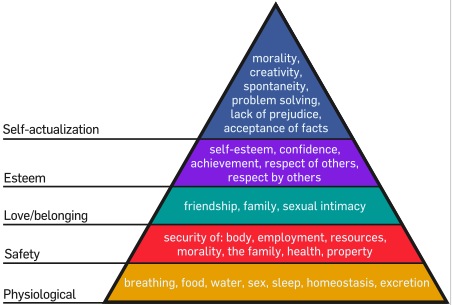
Psychologist Abraham Maslow created a 5-level theory of human motivation (Psychology Review, 1943) in which he proposed that peoples’ needs and satisfaction move ‘upwards’ through a common structure which he called a ‘hierarchy of needs.’ Once lower needs of sustenance and safety are met, we aspire to fulfill social, self-esteem, and self-actualization needs. The summary chart looks like this:

Mazlows Hierarchy MBA Using Maslows hierarchy of needs to develop the why an MBA / goals essay

credit: Wikipedia

(The model made Maslow world famous. The structure of the pyramid itself has been tinkered with over time, for example by Manfred Max-Neef, who sees levels of: subsistence, protection, affection, understanding, participation, leisure, creation, identity, freedom.) But the core insight remains: once more basic levels of fulfillment are achieved, and as long as they remain achieved, humans moves up the hierarchy in search of fulfillment.

What does this have to do with MBA admissions essays, and how does this help those struggling with the ‘why an MBA?’ question in particular?

It helps because it provides a quick, reliable guide to the necessary reach of the essay. Too often applicants dwell in and around levels 2 and 3, talking of security and quality of employment, taking care of their family (including elderly or immigrant parents) and developing friendship and contact networks (incl. alumni networks), career progress, and so on.

This is all important. But there is more to say, and Maslow shows the way to developing it. Where is the rest of your motivation going to come from in your life: how will you achieve further self esteem, self-respect, and the respect of others? What will you create? What will put you, personally, to higher plain of self-actualization?

As I tell my clients: A good career and family security are great things to want. But what else is there? What comes after that? You don’t need to aspire to be Nelson Mandela or Mother Theresa, but you do need to reach into yourself and ask: ‘My levels 4 and 5 - what are they, for me? What would actualizing myself at these levels look like? And how will an MBA be part of what takes me there?’

2 responses so far

SEO Powered by Platinum SEO from Techblissonline

Switch to our mobile site