Tag Archive 'Stanford GSB'

Oct 26 2011

Profile Image of Avi Gordon
Avi Gordon

A GMAT Reality Check

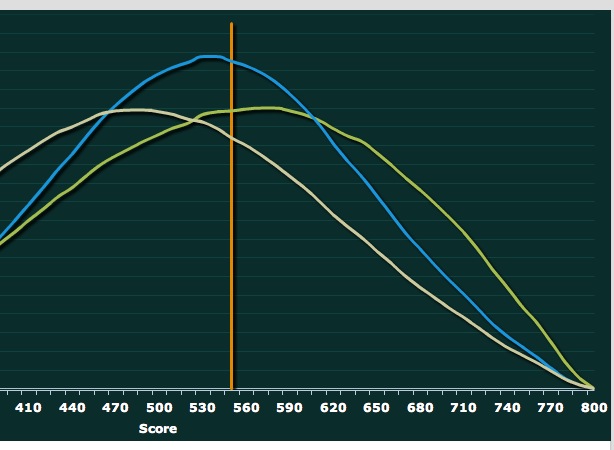
A client recently sent me this handy new utility from GMAC, purveyors of the GMAT, which allows test-takers to rate their score with reference to their cohort filtered by intended degree, age, gender, country, and so on.
GMAT A GMAT Reality Check

If you try it you will be able to see how you stack up against the sub-group you are really competing against.

You may also take heart that the median is much lower than you think. True, this doesn’t help “GMAT paranoia” when you look at your elite school and find it has an average accepted GMAT of 720 and your score is 680…

For that you need to absorb what the schools keep telling us — once again here in a recent WSJ interview with Derrick Bolton Director of MBA Admissions at Stanford GSB — which is that the GMAT is only one among many factors that determine admission.

WSJ: “Do you check out the GMAT score and if it’s below a certain number, put that application aside?”

Bolton: “That would rob us of a lot of talent. The GMAT is helpful in terms of understanding how someone can perform in the first year, but that’s one small piece of the overall M.B.A.”

What would be nice, for the next iteration of this GMAC utility, would be the ability to check a box that shows the GMAT arc of accepted students at Stanford, or Harvard, or Tuck, etc. That arc would by definition show the 50% below the incoming median score, and how low incoming scores can be, and that would be reassuring to the many hundreds of applicants who will get into elite schools despite not being “GMAT geniuses.”

See also I Scored 700, Should I Retake? and The Myth of the 800 GMAT.

 

No responses yet

Jan 25 2011

Profile Image of Avi Gordon
Avi Gordon

HBS augments case method teaching: a call to ‘doers’

Harvard Business School this week announced first moves toward its long-awaited curriculum reform in an email from Dean Nitin Nohria and Senior Associate Dean Youngme Moon to incoming students. The essence of it is: HBS is creating a new required first-year course called “Field Immersion Experiences for Leadership Development” (FIELD), and will provide greater modularity and student choice in the second year.

By all accounts the reforms are not huge, and not as extensive as those undertaken by Wharton, Stanford, Yale, Haas, and other major programs recently. It appears that HBS’s strategy is to introduce reforms in a incremental, rolling way.

But there is a radical kernel in the FIELD program, something HBS applicants should note. According to the deans’ statement, the course will focus on developing substantively meaningful small-group learning experiences that are “experiential, immersive, and field-based.”

Elaborating on this, Brian Kenny, chief marketing and communications officer for Harvard Business School, was quoted as saying: ”For most of the last 100 years, we have been exclusively using a case study pedagogy. We’re recognizing that the case method needs to be supplemented with experiential things that allow students to balance knowing with doing.”

In other words, “doing” is moving up the list of what’s crucial at HBS. They are looking to graduate “doers” rather than merely “knowers.” Of course Harvard will claim they have been doing this all along, but part of the enduring criticism leveled against business schools, particularly in the wake of the Credit Crunch, is that “book learning” is not enough to make a good business leader.

The case method is in itself a hybrid between a straight textbook learning and the real world, and this is what made it powerful in a world where some other b-schools taught more rote style. But the world has moved on, and “experience” and “immersion-fieldwork” have become central to what all serious b-schools consider valuable in formative management education. Of course, the case method will still be at the heart of the Harvard’s teaching. But there is a clear manifesto to nudge the case method further towards the real world by augmenting it with immersion.

How does this affect admissions? Quite simply, HBS is looking, more than ever, to turn out graduates who are ready, willing, and able to roll up their sleeves and immerse themselves in their leadership projects. So you-the-applicant should look to show where and how you have successfully navigated “immersion” projects in your past, what learning experiences you will immerse yourself in while at HBS and in your near-term future, and how the FIELD experience will help you do it better.

No responses yet

Dec 03 2010

Profile Image of Avi Gordon
Avi Gordon

‘Dedicated to the things that haven’t happened yet and the people who are about to dream them up’

I spent a few minutes today catching up with the Stanford GSB Dean’s “State of the School, Fall 2010″ message, which anticipates the GSB’s move into the new Knight Management Center in Spring 2011.

Stanford Knight Center Dedicated to the things that havent happened yet and the people who are about to dream them up

What caught my attention, from an MBA admissions perspective, is the inscription on the new cornerstone of the new center. How is that for clarity in what Stanford GSB is looking for? Dreaming up — and presumably then building — new things is, literally, the cornerstone of the institution.

So if you are applying to Stanford GSB, you need to have some idea of what (ambitious) business or organization or innovation you may dream up, why it’s important to the world, why you are the person to do it, why SGSB can expect you to succeed, and a sense of how they can help you.

Is this saying, “think small?” Is this saying, “comfortable career track?” “Sure, we want to educate you so you can be a trader in an I-bank, or telecoms strategy consultant…?” I think not. They are not demanding mainline entrepreneurship exactly, but they are demanding those ready, willing, and able to build big new things in the world.

It’s also worth spending the 4 minutes it takes to watch Dean Saloner’s presentation, below, because he integrates key elements in the business school education framework, from perspective to foundations to critical-analytical thinking to innovation to personal leadership in a very joined-up way. As an applicant, it’s worth pausing to think how this simple pattern can be used to structure stories and events in your own life that you are trying to tell Adcom about.

.

No responses yet

Oct 29 2009

Profile Image of Avi Gordon
Avi Gordon

The little story of the business school and the avocado

In my book ‘MBA Admissions Strategy’ I offer the following advice: ‘Proofread to show your hunger’ (that is, hunger for admission, a real desire to be selected.) Typographic or other careless errors in your text immediately clues Adcom in as to how (un)careful you were with your text, and this tells them not only how organized and detail-oriented you are — whether you are a ‘finisher’ — but also how much you actually really care about your application to their particular school.

In this sense MBA admissions works just like a resume you send out for a job. If there’s one error in it, eyebrows will be raised. Two errors and you may as well not have sent it.

The longstanding ‘pet peeve’ across all schools is that the wrong school name often appears in the text. That is, Stanford GSB Adcom gets essays that say: “I would contribute to my peer learning environment at Wharton by …” Ouch.

Famously, the spellchecker will help you a bit, but is not foolproof. It will happily let you say your first mentor was your high school principle. It will not replace Booth with Tuck. Nor does it know that Haas is a business school, but Hass is an avocado.

The tricky thing is that you, the essay-writing applicant, can’t proofread your own work. Obvious errors will go undetected because you will be focused (rightly) on content and value delivery. The MBA Admissions Studio does not offer this service either, for the same reason. Proofreading should be done by someone who is seeing the essays for the first time, and who is tasked with looking for errors (not reading for content or value assessment.)

No responses yet

Sep 09 2009

Profile Image of Avi Gordon
Avi Gordon

MBA essay word count: we can’t go over it. We can’t go under it. Or can we?

“How strictly do I have to stick to the essay word limit? How much can I go over? Does it matter if I’m under?” is a question I get a lot from clients and people who pop up on email.

To answer this, it’s essential, as always, to think about any process or task or limit in admissions from AdCom’s point of view. Put yourself in their shoes. Why do they ask for it? What are they trying to achieve? How does it help them?

So, what is AdCom trying to do with word limits? First, if there were no limits applicants would ask incessantly: “Please Miss, how long must it be?” Second, some applicants would write the great American novel, which would waste their time and the Committee’s. Third, limits provide a way of getting essays from different applicants to be more directly comparable, being the same length.

But there is play in the system. The purpose of the essays is to get to know the applicant via their writing, and everyone knows that writing is a creative process and certainly nobody expects you to hit the word count on the nail. This is not engineering or accounting. (Believe it or not, some clients fuss the word count until they have exactly the number asked for, taking touching comfort in a detail that will provide them absolutely no refuge.) Anyway, application forms often talk about a word “guide” rather than word “limit.” So you can clearly go a bit over, but by how much?

My advice to clients is not to go more than +5% in any essay. This kind of margin is a natural “rounding error” in finishing up what you have to say and will not hurt you if your reader is a reasonable person, which we assume she is. More than this will start to look like you are taking advantage and/or asking for an indulgence that your competitors are not getting.

However if you write a number of essays that are noticeably short it is fine to have one or two that are commensurately longer, so that the whole comes out more or less right. In fact, Stanford GSB explicitly allows this: its guidance is both per essay and for the essay set as a whole (1,800 words), so you are invited to trade off between essays as you see fit. How well you do this is, by the way, a test of your communications judgment.

Can you go under the limit? Similarly, I advise clients not to go less than -5% on any essay. In one sense, like all professional communicators, I believe strongly in “say what you have to say; say it once, strongly and clearly and then stop talking.” This is the royal road to more powerful communications. Certainly there’s no merit in padding, wafffling, and repeating yourself. But admissions essays are relatively short pieces of writing, and you — if you merit a place at a top b-school — are a multifaceted, talented individual with an valuable track record, and if you can’t find things to say to take up the word count this in itself flags that you have not been able to (or haven’t bothered to) properly investigate your own motivations or fully argue your merits.

No responses yet

Jun 01 2009

Profile Image of Avi Gordon
Avi Gordon

Stanford GSB essays 2009/2010: the focus is tightened towards results and successes

Stanford’s essays are notoriously “introspective” and give many applicants trouble. Stanford Adcom do really want to get to know the real you through your writing. This year the flavor is the same, but (and possibly to avoid waffle) some important tweaks have been made in the optional essays to shift the focus squarely towards communicating successful results.

Why results? Because successful outcomes are hard to achieve. Anyone can tell a good story, particularly about what great things they may do in the future. That’s important. But if you can twin it with proof of past success, then it sounds like you are likely to hit your targets in life.

Stanford GSB Application Essays

  1. What matters most to you, and why? (750 words recommended)
  2. What are your career aspirations? How will your education at Stanford help you achieve them? (450 words recommended)
  3. Answer two of the four questions below. Tell us not only what you did but also how you did it. What was the outcome? How did people respond? Only describe experiences that have occurred during the last three years. (300 words recommended).
    Option A: Tell us about a time when you built or developed a team whose performance exceeded expectations.
    Option B: Tell us about a time when you made a lasting impact on your organization.
    Option C: Tell us about a time when you motivated others to support your vision or initiative.
    Option D: Tell us about a time when you went beyond what was defined, established, or expected

Here is where successful outcomes results-orientation has been upgraded. In Option A they have added “whose performance exceeded expectations.” Option B used to be “Tell us about a time when you felt most effective as a leader.” Now “the lasting impact” demands a results-oriented perspective. Option D remains from last year: this is a directly results-oriented question.

Stanford GSB Application Deadlines are:
Round 1: October 7, 2009
Round 2: January 6, 2010
Round 3: April 7, 2010

One response so far

SEO Powered by Platinum SEO from Techblissonline

Switch to our mobile site